

At the heart of everything Verdigris does is a simple act: two people walking together. But the simplicity of that act belies the care, structure, and expertise that surrounds it. We recruit volunteers from across Dumbarton and West Dunbartonshire — people of all ages, backgrounds, and walks of life who have in common a willingness to show up consistently for someone who needs company.
We train those volunteers thoroughly, match them thoughtfully with participants, and support them carefully so that they can give their best to the people they walk alongside. Our participants include older people living alone after bereavement, adults with mental health conditions or physical ill-health who have gradually withdrawn from social life, people who have moved to Dumbarton and not yet found their feet, and anyone else for whom loneliness has become a significant feature of daily life.
Our routes make the most of what Dumbarton offers: the wide path along the River Clyde with its views to the Kilpatrick Hills, the grounds of Levengrove Park, the slopes and viewpoints around Dumbarton Castle and the remarkable volcanic Rock that has defined this town's skyline and history for centuries.
We believe the landscape is therapeutic in its own right, and we are deliberate about using it. Participants regularly tell us that the combination of fresh air, movement, and genuine conversation is more effective than anything else they have tried in addressing the grey heaviness of isolation.
We collect outcomes data rigorously — using validated tools including the UCLA Loneliness Scale and the Warwick–Edinburgh Mental Wellbeing Scale — because we are committed to demonstrating our impact and to making the case for befriending as a serious, evidence-based health intervention.
From individual befriending matches to NHS referral partnerships, every strand of our work is designed to be practical, evidence-based, and human.
Our core programme matches a trained volunteer befriender with an isolated resident for regular walks at a pace and route that suits them.
Matches are made carefully, taking into account personality, interests, physical ability, and availability. Befrienders and participants meet at least twice a month, usually weekly, for walks that typically last between 45 minutes and an hour and a half. Routes are chosen together and often follow the Clyde path, Levengrove Park, or the paths around Dumbarton Rock. Our coordinators check in with both parties regularly, and every befriender has access to ongoing training and a named support contact.
Small, friendly group walks for people who want broader social connection alongside — or as a step toward — one-to-one befriending.
Group sessions run weekly in two locations across Dumbarton, each led by a trained walk leader and a volunteer assistant. Groups are kept small — usually six to ten participants — to ensure everyone feels seen and included rather than lost in a crowd. Sessions end with an optional tea and conversation at a local community venue, and many lasting friendships have formed through this programme. Group walks are also a valuable pathway for people who are waiting for a one-to-one match or who want a lighter-touch first point of contact with our service.
We invest in our volunteers from day one, providing comprehensive induction, safeguarding training, and ongoing development throughout their time with us.
Our volunteer training programme covers active listening, safeguarding adults, boundaries and self-care, understanding loneliness and its health impacts, and practical elements including what to do in an emergency on a walk. Training is delivered in person in Dumbarton and is accredited through the Scottish Voluntary Sector training framework. Volunteers also attend regular peer support gatherings where they can share experiences, raise concerns, and celebrate the connections they are helping to build. We have trained over 80 volunteers since our founding.
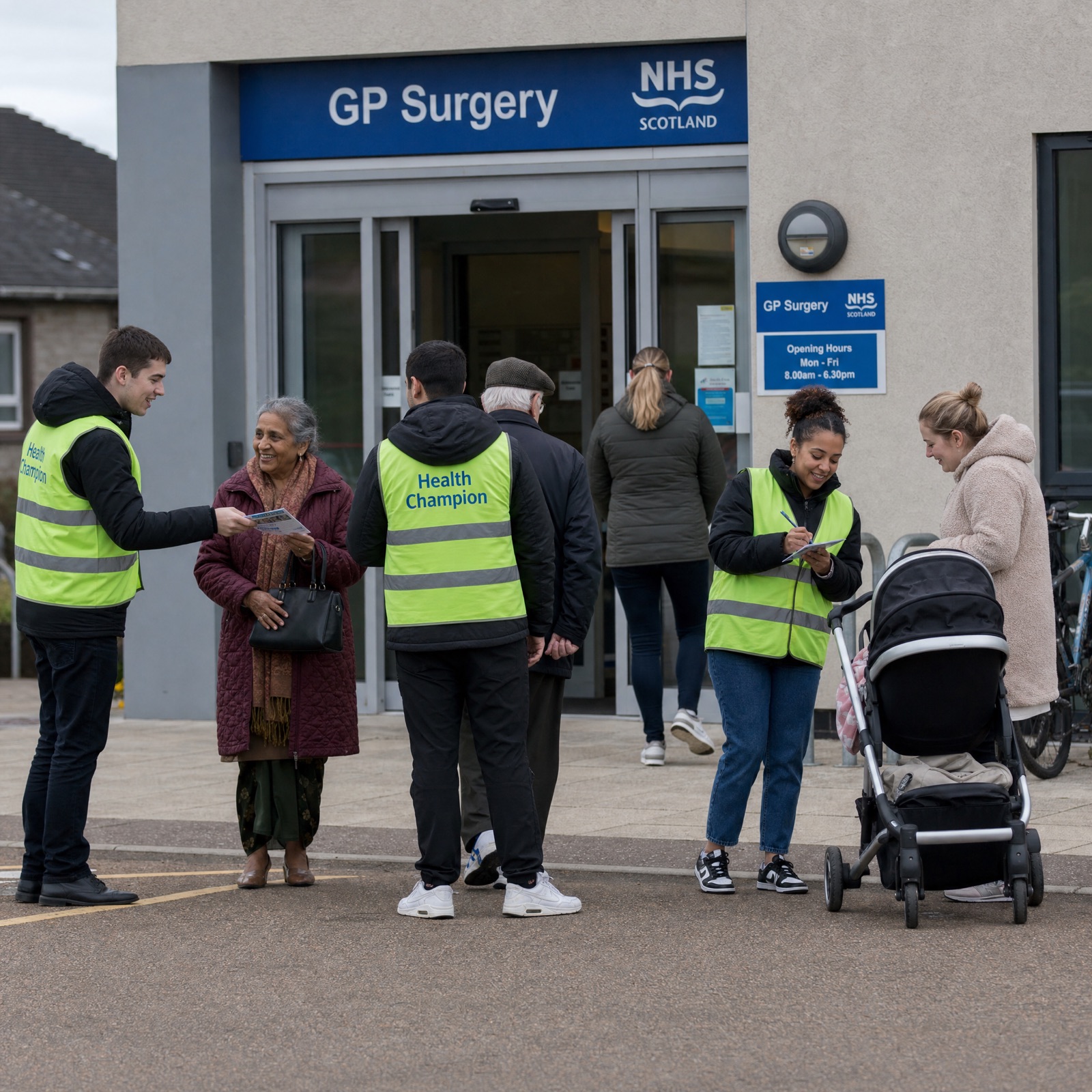
We work directly with NHS Greater Glasgow and Clyde, West Dunbartonshire Health and Social Care Partnership, and local GP practices to receive and act on referrals for isolated patients.
Our social prescribing pathway allows GPs, community nurses, social workers, and link workers to refer patients directly to Verdigris with the person's consent. We respond to all referrals within five working days, conduct a brief wellbeing conversation with the prospective participant, and aim to have a befriending match in place within four weeks of referral. We report back to referrers with anonymised outcome data and work collaboratively on complex cases where a person's isolation is one element of a wider support picture.
If you are a GP, community nurse, social worker, link worker, or other professional working with isolated residents in West Dunbartonshire, we welcome referrals. With the person's consent, please get in touch and we will respond within five working days.